
Understanding the Technologies
What Is Thermal Imaging?
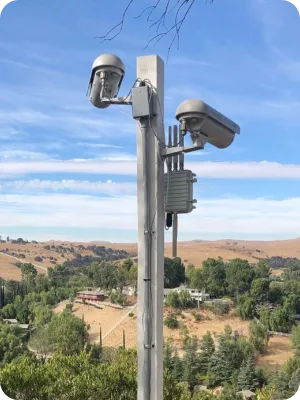
Thermal imaging cameras detect radiation in the infrared spectrum, which is invisible to the human eye. Everything that has a temperature above absolute zero emits some level of infrared energy. Thermal cameras convert that energy into an image that shows temperature differences across a scene. In simple terms, instead of seeing what light looks like, a thermal camera “sees” heat.
This makes thermal imaging extremely valuable in Wildfire Detection, where early signs of danger often appear as subtle increases in temperature long before visible smoke or flames emerge. A thermal camera mounted on a tower or drone can detect a small hotspot hidden beneath vegetation, identify heat through dense smoke, and even operate effectively during nighttime hours. Because it does not rely on visible light, thermal imaging remains functional when optical systems fail due to darkness or thick atmospheric conditions.
However, thermal imaging is not perfect. It can sometimes misinterpret non-fire heat sources, such as sun-heated rocks, vehicle engines, or power lines. The sensors must be properly calibrated and often combined with intelligent algorithms to distinguish real fire activity from background heat variations. Despite these challenges, thermal technology is one of the most reliable methods for continuous, around-the-clock wildfire monitoring.
.
What Are Traditional Cameras?
Traditional cameras, sometimes referred to as optical or visible-light cameras, capture images using the same spectrum of light that human eyes can see. These systems rely on ambient light, which means they perform best in daylight or with artificial illumination. Their main strength lies in their ability to provide high-resolution, color images that show context—trees, terrain, smoke, vehicles, and structures. This visual clarity helps human operators and AI systems confirm whether an event detected by another sensor, such as a thermal camera, is actually a fire.
Traditional cameras are widely used because they are affordable, easy to deploy, and compatible with existing video infrastructure. However, they face major challenges in Wildfire Detection, especially in smoke-heavy environments, fog, or during the night. Optical systems can struggle to detect the early heat signals that precede a wildfire and can also be misled by visual noise like dust, glare, or moving shadows.
Even with these limitations, traditional cameras remain valuable because they offer visual confirmation of events and can provide important situational awareness once a fire has been detected. Fire management teams often rely on this contextual imagery to make operational decisions, direct firefighting units, and assess risks to nearby structures or communities.
.
Comparative Analysis
Detection Accuracy and Night vs. Day Operations

When it comes to detection accuracy, thermal imaging has a clear advantage in identifying early-stage fires. Because it detects heat rather than light, a thermal camera can recognize a small temperature anomaly even if no visible smoke or flames are present. This is especially important in remote forests, where early detection can mean the difference between a manageable blaze and a catastrophic wildfire.
During the night, thermal imaging remains fully operational. It does not depend on sunlight or artificial lighting, and in fact, cooler nighttime temperatures make heat sources even easier to distinguish. A thermal camera mounted on a tower or drone can identify a hidden hotspot hours before an optical system would have any visual indication.
Traditional cameras, by contrast, depend entirely on visible light. They perform very well during daylight when visibility is clear, and they can detect smoke plumes that thermal systems might miss if heat levels are still low. But as soon as the sun sets, their effectiveness drops dramatically unless they are paired with artificial lighting, which is not practical for remote wildfire surveillance.
This is where artificial intelligence becomes essential. Modern AI systems can analyze thousands of image frames in real-time, comparing temperature gradients or smoke patterns to vast training datasets. AI algorithms help thermal imaging systems ignore harmless heat sources such as sunlit rocks or warm mechanical structures. Similarly, for optical systems, AI can distinguish between real smoke and harmless cloud formations, fog, or dust. By training these systems on diverse datasets, developers are teaching them to reduce false alarms and improve accuracy across all conditions.
In short, while thermal imaging excels in early detection and nighttime operations, traditional cameras still play a vital role during daylight, when visual confirmation can guide response teams. Together, they create a comprehensive detection framework that functions continuously, day and night.
.
Environmental Adaptability
Atmospheric Conditions: Smoke, Fog, and Haze

Wildfires often generate thick smoke that can block visibility across miles. In such conditions, thermal imaging offers a major advantage because it penetrates smoke and haze. Since it measures infrared radiation, it can “see” through many types of atmospheric particles that scatter visible light. This makes thermal cameras especially effective for spotting hot zones that might be completely hidden from view by smoke.
Traditional optical cameras, on the other hand, lose much of their usefulness in smoke-heavy or foggy environments. Visible light is easily scattered by fine particles, meaning that even a small amount of smoke can obscure what the camera sees. When line-of-sight visibility drops, optical systems often struggle to identify anything accurately.
Artificial intelligence helps mitigate this problem by processing visual data frame by frame, enhancing contrast, and using pattern recognition to identify smoke movement. AI can sometimes reconstruct a clearer image from low-visibility footage by filtering out noise and focusing on dynamic motion patterns. Yet even with such improvements, thermal imaging remains far more resilient in dense atmospheric conditions.
Lighting Conditions: Sun Glint, Shadows, and Nighttime
Lighting conditions are another critical factor in wildfire monitoring. Traditional cameras are sensitive to changes in sunlight, cloud movement, and terrain shadows. A strong glare from water or metal surfaces, or even the shifting of shadows across a hillside, can trigger false alarms if the system is not properly tuned. These “visual illusions” can mimic the appearance of smoke or flame, confusing both automated detection software and human operators.
Thermal imaging, by contrast, is immune to changes in visible light. It functions equally well under bright sunlight, partial shade, or complete darkness. The heat-based nature of thermal imagery means that shadows, glare, and reflections have almost no effect on its readings. This makes it a more stable and reliable choice for 24-hour Wildfire Detection operations.
Still, combining both systems yields the best results. Optical cameras provide color context—showing vegetation, terrain, and smoke direction—while thermal cameras offer continuous heat-based monitoring. By integrating these feeds, operators gain a more complete understanding of the situation. A smoke plume detected by an optical camera can be cross-verified by thermal imaging to confirm whether it originates from an actual heat source, minimizing the risk of misinterpretation.
.
The “False Positive” Dilemma
False positives are one of the biggest challenges in automated Wildfire Detection systems. A false positive occurs when a monitoring system incorrectly identifies something as a fire. This can lead to wasted resources, unnecessary alerts, and decreased trust in the system over time. Both thermal and optical cameras are susceptible to this issue, but in different ways.
Thermal imaging systems may trigger false alarms when they detect heat sources that resemble fire. These could include sunlit boulders, asphalt roads, engine exhaust, or even reflections from solar panels. Because thermal cameras are highly sensitive, they need intelligent filtering to distinguish between natural temperature variations and the signature heat of combustion.
Optical cameras face a different set of challenges. They can be fooled by smoke-like visuals—clouds, mist, fog, or even dust. Movement of shadows or rapid changes in lighting can also confuse visual recognition software. On windy days, a cloud’s shifting edge might appear like rising smoke to an untrained detection algorithm.
Artificial intelligence again plays a crucial role here. AI models can analyze large datasets to learn the difference between true wildfire indicators and harmless background activity. By correlating data from multiple sensors, an AI system can confirm whether a heat signature aligns with visual evidence of smoke or flame. Over time, this learning process greatly reduces the false alarm rate, improving trust in automated systems and ensuring that emergency response teams are only dispatched when genuine threats exist.
.
Bandwidth and Data Efficiency
In remote areas where most wildfire detection towers are located, bandwidth is often limited. Many of these monitoring stations rely on cellular or satellite connections, which have restricted data capacity. In such environments, thermal imaging has a surprising and important advantage.
Thermal video streams require far less bandwidth than high-resolution optical streams. A thermal camera might transmit compact grayscale images or heat maps that are small in file size but rich in critical information. In contrast, a 4K optical video feed can consume enormous amounts of data due to color depth and high pixel count. This makes optical cameras more challenging to operate in regions where network infrastructure is weak.
Because thermal data is more compact, it can be transmitted continuously, even over limited connections, allowing real-time monitoring and analysis from distant command centers. This efficiency becomes crucial when scaling up large networks of sensors across national parks, forests, or mountainous terrain.
At the same time, optical cameras provide valuable details once a potential fire has been identified. They allow operators to visually assess smoke color, flame size, and spread direction—data that thermal systems alone cannot provide. Some of the most advanced wildfire monitoring systems now use a hybrid approach, streaming low-bandwidth thermal feeds for constant scanning while only activating high-resolution optical streams when a potential fire event is detected. This approach saves bandwidth, reduces costs, and still provides full situational awareness.
.
Challenges and Future Outlook

Despite their strengths, both thermal and traditional camera systems face ongoing challenges. Hardware costs, calibration requirements, and environmental variability can affect performance. Thermal cameras, especially those with high sensitivity, are more expensive and require precise maintenance to ensure accurate temperature readings. Optical systems, though cheaper, are limited by visibility and lighting.
Artificial intelligence is quickly becoming the bridge that unites these two technologies. Through machine learning, neural networks can process massive volumes of sensor data, identify subtle patterns, and make accurate predictions about fire behavior. Edge computing—where processing happens directly on the camera or near the source—reduces the delay between detection and alert, allowing for faster response times.
In the future, we can expect hybrid systems that merge thermal and optical data streams into a single, intelligent platform. These systems will automatically balance their inputs, using thermal imaging for heat-based scanning and optical cameras for contextual confirmation. When a potential fire is detected, AI software will cross-check multiple parameters—temperature, color, motion, wind direction, and location—before sending an alert.
There are also advances in satellite-based thermal monitoring, drone surveillance, and long-range optical zoom cameras that can cover hundreds of square kilometers. These innovations will make wildfire monitoring more comprehensive and precise, providing not only early detection but also real-time situational intelligence during firefighting operations.
Ultimately, the goal is not just to detect wildfires faster but to understand and predict them. By analyzing years of sensor data, machine learning algorithms could identify patterns that precede ignition events, allowing authorities to take preventive actions before flames ever appear.
.
Conclusion
Thermal imaging and traditional cameras each bring unique strengths to Wildfire Detection. Thermal systems provide unmatched capability in detecting heat anomalies, operating through smoke and darkness, and conserving bandwidth in remote monitoring networks. Traditional optical cameras contribute a high-resolution visual context that helps confirm detections and guide firefighting decisions.
When combined—and enhanced with artificial intelligence—these two technologies form a powerful, integrated detection system that works around the clock, in all weather and lighting conditions. Such hybrid systems reduce false positives, optimize data usage, and enable faster, more accurate responses to emerging fire threats.
As wildfire risks continue to rise, the integration of thermal imaging, optical monitoring, and AI-driven analytics represents the future of early detection. This fusion of heat-based insight, visual confirmation, and intelligent automation could transform how we protect forests, wildlife, and human communities from one of nature’s most destructive forces.
In the ongoing battle for faster and smarter Wildfire Detection, the answer is not choosing one technology over another—but combining them to create a more resilient and intelligent defense system for the planet’s most vulnerable landscapes.