
Wildfires are already among the most complex emergencies faced by fire services. They involve rapidly changing conditions, incomplete information, and high-stakes decision-making under time pressure. When unexploded ordnance (UXO) is present in the landscape, this complexity increases exponentially — not only operationally, but ethically and strategically.
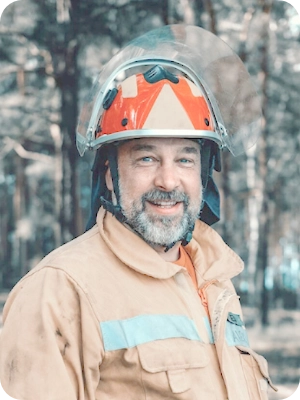
In UXO-contaminated environments, fire is no longer just a vegetation problem. It becomes a multi-hazard incident where suppression actions themselves may trigger explosions, restrict access, or put responders in unacceptable danger. As Alexander Held explains, these landscapes expose a growing operational response gap between wildfire risk and the tools firefighters are legally and physically able to use.
UXO Is Not a Local or Temporary Problem
UXO-contaminated fire landscapes are not limited to active conflict zones. Across Central and Eastern Europe, the Balkans, and former military training areas, forests and heathlands remain saturated with legacy ordnance decades after conflicts ended. Climate change is now pushing these areas into higher fire frequency, longer seasons, and more extreme fire behavior — increasing the likelihood that wildfire will intersect with contamination.
The challenge is not theoretical. It is operational, recurring, and expanding.
The Operational Response Gap
In contaminated areas, standard wildfire doctrine often collapses. Firefighters may be required to keep hundreds of meters — sometimes over a kilometer — away from the fire edge. Direct attack becomes impossible. Heavy machinery cannot be used safely. Aerial tactics are restricted by altitude rules and safety distances that severely reduce effectiveness.
Yet these restrictions often collide with reality: communities, infrastructure, and critical assets still need protection. Incident commanders are forced to choose between doing nothing or accepting elevated risk — a dilemma that has no easy answer.
Why UXO Breaks Standard Fire Tactics
UXO introduces invisible, unpredictable hazards:
- Heat transfer through soil can increase detonation probability
- Mechanical impact from suppression or vehicle movement can trigger explosions
- Fire behavior assessment is constrained by uncertainty below the surface
Even when ordnance does not detonate during active fire, it remains a persistent hazard during mop-up, investigation, and recovery. Fire may be controlled — but the danger is not gone.
Combining Old Fire Principles with New Tools
One of the most practical paths forward is not radical innovation, but adaptation. Classic wildfire principles — fuel removal, control lines, and burnout operations — still work. The difference is who or what performs them.
Remote-controlled armored demining machines can create mineral control lines in contaminated terrain without exposing crews. Aerial ignition drones can apply controlled fire from secure anchor points. Together, these tools allow firefighters to apply proven tactics while respecting safety constraints.
Prevention as a Strategic Advantage
Timing matters. Under cooler, higher-moisture conditions, controlled burning can be significantly safer than peak-season wildfire. In some cases, early fuel reduction not only lowers future fire intensity but also exposes ordnance visually, enabling later removal by EOD teams. This shifts wildfire management from reactive suppression toward proactive risk reduction.
Closing the Gap
There is no universal SOP for wildfire in UXO-contaminated landscapes. Progress depends on shared learning, cooperation between fire services and demining experts, and realistic, field-tested solutions. The goal is simple but critical: give incident commanders safe, usable options when wildfire meets contamination.
At SmokeD, we see ourselves as part of the same team as firefighters, land managers, and researchers — working together to protect forests and respond to wildfire risk before it becomes a disaster.