
Fighting wildfires is sometimes jokingly called “extreme gardening.” And although it sounds absurd, there’s quite a bit of truth in that description. Unlike city firefighting, here sometimes all it takes is raking leaves. That’s why wildland firefighters aren’t just flame-fighters. They more often act like gardeners, shaping the landscape so the fire has nothing to feed on. And sometimes, they even set controlled fires themselves.

Why “gardening”?
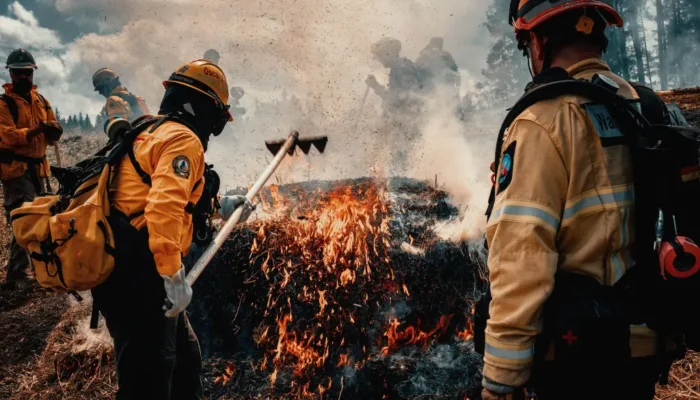
Their equipment looks more like a gardener’s tools than a city firefighter’s gear. Large and heavy hoses with enormous diameters or water cannons are replaced with lightweight garden hoses – much easier to drag through thick brush on steep slopes. Water is pumped using portable pumps with engines that look like they came from a lawnmower. Wildland pumps are small enough to sling over your back and hike into the mountains, drawing water from a stream or a barrel set up in the field. Add hoes, axes, backpack sprayers, and of course chainsaws. Does this sound more like a firefighter’s kit or a gardener’s?

Why “extreme”?
The difference from gardening in a backyard is significant. Instead of calmly trimming bushes, it’s done in the mountains, in smoke and extreme heat, with fire that poses a real threat to their lives. Instead of pruning shears – chainsaws. Instead of a watering can – 20-liter backpack pump. Instead of a rake – a heavy Pulawski axe. And all of this takes place deep in the wilderness, far from civilization, not between the carrot and orchid beds.
Fighting fuel, not flames
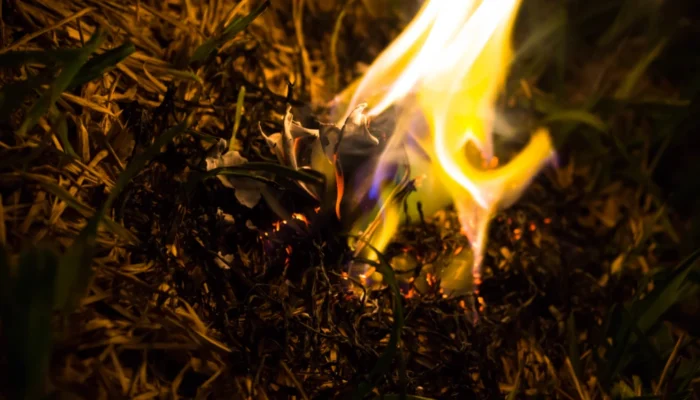
The most important task when combating fires in wild and inaccessible areas is reducing the available fuel. Creating control lines that serve as firebreaks, thinning vegetation, and removing dead branches protects the forest more effectively than dumping thousands of liters of water directly onto the blaze. Sometimes wildland firefighters use methods that might seem paradoxical to a layperson – like controlled burning. This involves deliberately setting small areas on fire to remove fuel from a larger fire. It’s a practice as old as agriculture itself, but scaled to entire landscapes and carried out under full control. A firefighter with a torch trying to burn vegetation has more in common with a farmer burning a pile of branches than with a city firefighter working mainly with the opposite element – water.

Meteorologist and gardener in one
Out in the field, the key isn’t just the chainsaw or the hoe. It’s also the weather forecast. Just as a gardener checks for approaching frosts, a firefighter in the forest must know how the wind will change, whether a storm is coming, and when conditions might shift. Lives depend on this information. A sudden change in wind direction can turn a safe line into a deadly trap in minutes. Drop in humidity and a rise in temperature can make the fire spread rapidly. That’s why every wildland firefighter is part meteorologist, and the weather forecast can literally save a firefighter’s life.
Knowledge of plants
Equally important is understanding the vegetation, because it is the fuel in the physico-chemical reaction of combustion. Firefighters need to know which species feed the fire and burn quickly, which can generate firebrands, and which burn slowly enough to help slow its spread. Knowing the plants means the difference between safety and danger. I probably don’t need to add that, in a way we could say the same about a gardener.

Protective equipment
Even the clothing of wildland firefighters differs from what’s familiar in the urban areas. Instead of heavy, heat-resistant jackets or gas-tight suits, out in remote terrain they make do with lightweight yellow shirts, durable trousers, leather gloves, and sturdy high leather boots. In the forest, lightness matters. Operations last for hours, days, or even weeks. Over time, every gram starts to weigh heavy. Long-lasting operations require firefighters to wear helmets for many hours, so they must be lightweight. These helmets don’t cover the entire head and have no visors. Wildland firefighting is more of a marathon than a sprint: prolonged clearing of shrubs, digging firebreaks, and dragging hoses up slopes demand immense effort. There’s no point wasting energy carrying heavy protective gear, and working in the wrong outfit could lead to dehydration and overheating of the body.
Motorized Wheelbarrows
Although wildland firefighters usually cover long distances on foot, often strenuous hikes, their vehicles also fit our metaphor. Instead of heavy fire trucks with ladders or tankers, the forest terrain is traversed by rugged pickups and lightweight ATVs – the equivalent of “motorized wheelbarrows” from gardening. They’re used to transport coiled hoses, fuel canisters, driptorches or small water tanks. Simple, mobile, and suited to mountain trails and off-road conditions. In this line of work flexibility and reliability matter more than the amount of water one can deliver.

Low-Tech in the Space Age
It may seem surprising that in the U.S., a country capable of sending probes to Mars, firefighters still walk on foot with hoes to dig firebreaks. At the same time, Spanish firefighters are encouraging shepherds to increase their goat herds. Yet this is not a sign of backwardness, but rather proof of the effectiveness of simple solutions. In extreme conditions, “low tech” often performs better than the most advanced technologies, because where the heavy cavalry of tankers can’t go, the light infantry with hand tools can always make it.
With a Torch in a Burning Garden
Those who fight wildfires are full-fledged firefighters. However, when you take a closer look at their work, it turns out they have more in common with gardeners than with firefighters battling burning buildings in the middle of large metropolitan areas. They work in dust, mud, and untamed vegetation, not in tidy backyard gardens, but across hundreds of hectares of dense mountain brush and wild forests. But admit it: a gardener raking leaves in a burning garden is already an extreme image, especially if a moment later, he’s the one setting vegetation on fire with a driptorch.